- Utkarsh Urvashi CHS, 1st Floor, Veshvi, Alibag
- info@sahyadriworldtrade.com
- Open: Mon–Sat: 08:00 – 18:00

Banana Export from India: Varieties, Packaging, Markets & Export Process
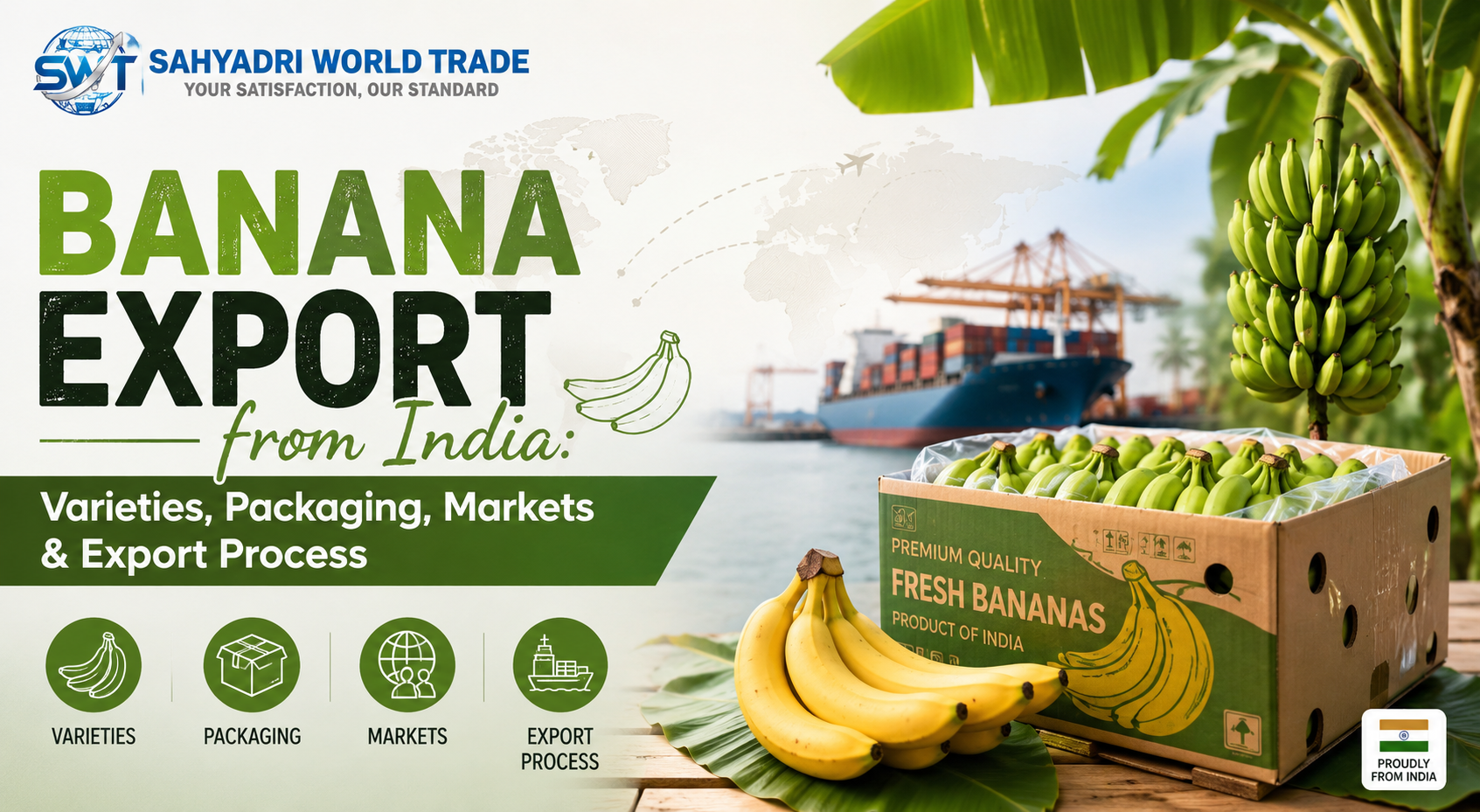
Banana Export from India: Varieties, Packaging, Markets & Export Process
India offers a wide range of banana varieties, including Cavendish, Robusta, Yelakki, Nendran, and Red Banana. But international supply involves more than selecting the fruit. Grading, maturity, packaging, documentation, handling, and destination requirements all influence whether a shipment reaches the buyer in suitable condition.
That is why choosing the right fresh banana exporter or banana supplier from India is an important part of the sourcing decision for importers, wholesalers, distributors, retailers, and food businesses.
Banana Varieties Exported from India
India produces several commercially important banana varieties, and the best choice depends on the destination, customer preference, transit conditions, and intended use.
Cavendish is widely used in international fresh-fruit trade because it lends itself to standardized commercial handling.
Robusta is another established commercial variety used across Indian supply chains.
Yelakki, also called Elaichi banana in some markets, is smaller, aromatic, and naturally suited to premium or specialty positioning.
Nendran is commonly associated with cooking and processing applications and may be suitable where buyers specifically require its characteristics.
Red Banana has a distinctive color, flavor, and market position that can make it relevant to specialty fruit buyers.
There is no universally "best banana variety for export." The appropriate variety depends on fruit size, maturity, appearance, shelf-life expectations, destination, and the buyer's market.
What Makes Bananas Export-Quality?
Export quality starts before packing. Bananas need to be selected with their complete journey in mind, including handling, storage, transportation, and final-market requirements.
Typical checks can cover:
- Size and uniformity
- Maturity
- Freshness
- Appearance
- Physical damage
- Pest or surface damage
- Foreign matter
- General product condition
Maturity is particularly important because bananas may need to reach the importer at a suitable stage for controlled ripening rather than arriving fully ripe.
A structured inspection process can include sampling different lots, grading fruit, separating unsuitable produce, and checking the shipment against specifications agreed with the buyer.
Banana Export Packaging and Shipping
Fresh bananas require packaging that provides protection while supporting practical handling during transportation.
Depending on variety and buyer requirements, export shipments may use corrugated cartons, protective liners, dividers, cushioning materials, and other suitable packing formats. Carton dimensions, net weight, labeling, and branding can be specified according to the destination and purchasing requirements.
Packaging should help reduce bruising, pressure damage, unwanted movement, and moisture-related problems.
For longer international shipments, logistics planning also matters. Sea freight can be relevant for larger commercial consignments, while temperature-controlled handling may be considered where appropriate for the product, route, and transit conditions.
There is no single storage or transit rule for every banana variety. Handling requirements should be established according to the actual product and supply chain.
Top Banana Importing Countries and Indian Banana Export Markets
The top banana importing countries globally include major markets across North America, Europe, Asia, and the Middle East. However, a country's overall banana imports do not automatically mean it is a major market for Indian bananas.
For an exporter and buyer, the more useful question is which Indian banana export markets can commercially support the required variety, quality, documentation, logistics, and pricing.
Indian fresh produce can be evaluated for destinations in the Gulf and Middle East, Europe, North America, and other international markets where the product and applicable import conditions are suitable.
For U.S. buyers, this distinction matters. The United States is a major banana-consuming and importing market, but buyers should not assume that Indian bananas automatically meet U.S. entry requirements. Current USDA Animal and Plant Health Inspection Service (APHIS), U.S. Customs, and other applicable requirements should be confirmed before shipment.
How to Export Bananas from India
Understanding how to export bananas from India starts with treating the transaction as a supply-chain process rather than simply a fruit purchase.
1. Define the buyer specification
Confirm the variety, size or grade, maturity, quantity, packaging, destination port, labeling, and expected shipment schedule.
2. Identify suitable suppliers
Source from farms, aggregators, or other supplier networks capable of meeting the required specifications and seasonal volume.
3. Grade and inspect the product
Representative samples can be checked for size, maturity, appearance, damage, and other agreed quality parameters.
4. Prepare export packaging
Pack the bananas using a format appropriate for handling, transit, buyer specifications, and destination requirements.
5. Complete export documentation
Depending on the shipment and destination, documentation may include commercial and shipping documents, certificate of origin, phytosanitary documentation, inspection certificates, or other required records.
6. Coordinate logistics and dispatch
Arrange loading, customs procedures, transport, and shipment according to the agreed commercial terms.
7. Maintain shipment records
Lot information, inspection records, photographs, packing details, and shipment references can support traceability and easier communication with the buyer.
Import-country regulations should always be verified before dispatch because requirements can differ by market and can change over time.
What Should You Expect from a Fresh Banana Exporter?
A serious fresh banana exporter should be able to discuss much more than the price per kilogram.
Before placing an order, buyers should understand:
- Where the bananas are sourced
- Which varieties and grades are available
- How quality is inspected
- What packaging options are offered
- How shipment documentation is handled
- What logistics options are available
- How quality complaints are addressed
- Whether repeat specifications can be maintained
For repeat business, recording agreed specifications for variety, size, maturity, packaging, labeling, inspection, quantity, and destination can make future procurement much more consistent.
Choosing a Banana Supplier from India
The right banana supplier from India should fit the buyer's actual sourcing requirements rather than simply offering the lowest initial quotation.
Sahyadri World Trade approaches agricultural sourcing around buyer specifications, supplier selection, product inspection, export-ready packaging coordination, documentation support, and shipment scheduling. Its sourcing network extends across Maharashtra and other agricultural regions of India, with the ability to coordinate trial quantities and larger commercial requirements depending on product availability and destination conditions.
For an international buyer, this structured approach can help turn a one-time purchase into a more repeatable sourcing arrangement.
Frequently Asked Questions
What banana varieties are exported from India?
Commercially relevant varieties include Cavendish, Robusta, Yelakki, Nendran, and Red Banana. Availability and export suitability vary by season, buyer specification, and destination.
Which Indian banana variety is best for export?
There is no single best option. Cavendish is important for standardized fresh-fruit trade, while Yelakki, Nendran, and Red Banana can suit specific market segments and applications.
How are bananas packaged for export?
Fresh bananas can be packed in export-suitable corrugated cartons and protective materials. Packaging depends on variety, net weight, handling requirements, buyer preferences, and destination.
How to export bananas from India?
The process generally involves defining specifications, sourcing suitable fruit, grading and inspection, export packaging, documentation, customs and logistics coordination, and shipment tracking.
What countries buy bananas from India?
Indian bananas can be evaluated for multiple international destinations, including markets in the Middle East, Europe, North America, and other regions. Destination suitability depends on current import requirements and commercial feasibility.
How long can bananas stay fresh during international shipping?
Shelf life depends on variety, maturity, packaging, handling, temperature management, and transit conditions. It should be planned around the complete logistics chain rather than a single fixed number of days.
How can I find a reliable banana supplier from India?
Ask about sourcing capability, available varieties, grading, quality inspection, packaging, documentation, logistics, and repeat-order procedures. A supplier should be able to translate your destination and product requirements into a clear shipment specification.