- Utkarsh Urvashi CHS, 1st Floor, Veshvi, Alibag
- info@sahyadriworldtrade.com
- Open: Mon–Sat: 08:00 – 18:00

Dehydrated Onion and Garlic: Benefits, Uses and How to Choose a Reliable Bulk Supplier from India
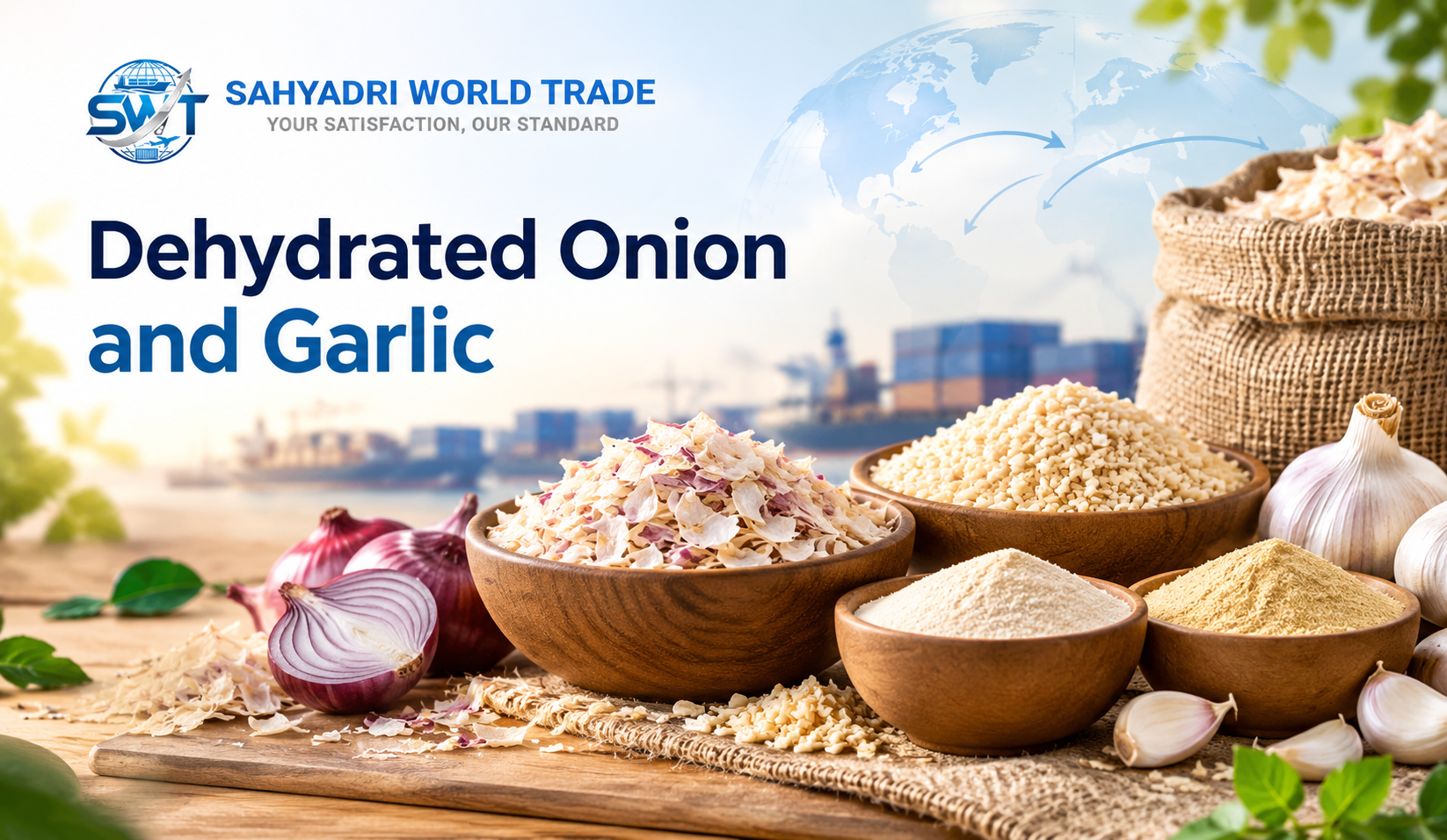
Dehydrated Onion and Garlic: Benefits, Uses and How to Choose a Reliable Bulk Supplier from India
For US businesses sourcing in bulk, the right supplier must offer more than an attractive quotation. Buyers should evaluate product specifications, food safety documentation, packaging, shelf-life information, traceability, shipment arrangements, and the supplier's ability to meet agreed requirements consistently.
India is one sourcing option for businesses exploring dehydrated vegetable ingredients. However, choosing reliable dehydrated onion exporters from India or dehydrated garlic suppliers in India requires checking each supplier's actual capabilities rather than relying on broad quality claims.
This guide explains the benefits, commercial applications, and key supplier-selection criteria to help US buyers make informed bulk purchasing decisions.
Why Are Dehydrated Onion and Garlic Used in Food Manufacturing?
Dehydrated onion and garlic are produced by removing much of the moisture from the raw ingredients through a controlled drying process. The resulting products can be processed into different forms according to their intended applications.
Their main advantage is practicality. Instead of washing, peeling, cutting, and preparing fresh ingredients for every production run, manufacturers can use preprocessed ingredients that fit established recipes and production workflows.
Other benefits include:
- Simplified ingredient handling: Ready-to-use formats reduce preparation work in commercial kitchens and manufacturing facilities.
- Convenient storage: Properly dried and packaged products generally offer longer storage potential than fresh equivalents, subject to product specifications and storage conditions.
- Consistent processing: Specified particle sizes and product forms can make ingredients easier to measure, blend, and distribute throughout a recipe.
- Flexible applications: Flakes, granules, minced pieces, and powders serve different production requirements.
- Potential logistics advantages: Removing water can reduce product weight and volume compared with fresh ingredients, although the actual shipping advantage depends on the product and packaging.
Dehydration does not automatically guarantee food safety, a particular shelf life, or a specific flavor profile. Those outcomes depend on processing, handling, packaging, and verified product specifications.
Common Types of Dehydrated Onion and Garlic
Before approaching a bulk supplier, identify the format that best suits your manufacturing process.
Dehydrated Onion Flakes
Onion flakes are suitable for applications where visible onion pieces or a more substantial texture are desirable. Depending on their specifications, they can be used in soup mixes, sauces, seasoning blends, ready meals, and selected snack products.
Businesses looking for Bulk dehydrated onion flakes should confirm the required flake size, color, moisture limits, and acceptable levels of fines or broken material.
Onion Powder
Onion powder provides a fine ingredient format for applications requiring even distribution throughout a mixture. It is commonly used in seasoning blends, marinades, sauces, dry mixes, and processed foods.
Buyers should confirm particle size, flavor characteristics, moisture specifications, and any requirements related to flow or blending performance.
Dehydrated Garlic Flakes and Granules
Garlic flakes and granules provide different particle sizes for industrial recipes, dry seasoning blends, sauces, and foodservice applications. The preferred format depends on the texture, processing method, and flavor distribution required in the final product.
Garlic Powder
Garlic powder wholesale purchasing can suit manufacturers, seasoning companies, distributors, and other buyers requiring garlic in fine, easy-to-blend form.
Before placing an order, check the particle-size specification, product composition, moisture limits, microbiological requirements, and packaging details. Different products should not be treated as interchangeable simply because they contain the same ingredient.
Availability of individual forms, grades, and specifications must be confirmed with the supplier.
Where Can Food Businesses Use Dehydrated Onion and Garlic?
These ingredients serve a wide range of commercial applications, depending on their specifications and compatibility with the recipe.
Food manufacturers can incorporate them into soups, sauces, gravies, instant meals, marinades, and dry mixes.
Seasoning and spice companies can use onion and garlic powders or granules in spice blends, rubs, flavoring mixes, and snack seasonings.
Snack manufacturers may use suitable dehydrated ingredients in coated snacks, crackers, savory mixes, and other seasoned products.
Restaurants and foodservice distributors can consider them for applications where standardized ingredients and reduced preparation work are useful.
Private-label brands, wholesalers, and importers may purchase suitable products for onward distribution to food manufacturers, retailers, and commercial kitchens.
The right choice depends on the intended application. A fine powder designed for a dry seasoning blend may not deliver the texture required in a soup or prepared meal. Before purchasing, establish the ingredient's intended use and share the relevant specifications with your supplier.
How to Choose a Reliable Bulk Supplier From India
Finding a potential supplier is only the first step. A structured evaluation helps buyers reduce uncertainty before committing to a commercial order.
1. Confirm the Product Specifications
Request a technical data sheet for each product under consideration. Depending on the product, this should address particle size, moisture content, color, composition, and other relevant quality parameters.
Clarify whether the supplier can meet your required specifications, rather than assuming every supplier offers the same grade.
2. Review Food Safety Documentation
Ask which food safety controls, certificates, and laboratory reports are available for the specific product and supplying facility.
Relevant checks may include microbiological testing, contaminant limits, and other parameters appropriate to the ingredient and intended use. Request current documentation and verify that it corresponds to the actual product, facility, and production lot where applicable.
For US imports, food safety and import obligations must be assessed for the product and transaction. The US Food and Drug Administration's Foreign Supplier Verification Programs (FSVP) requirements may apply to the importer, subject to applicable rules and exemptions. Buyers should confirm current requirements with qualified compliance professionals.
3. Check Packaging and Shelf-Life Details
Packaging helps protect dehydrated ingredients from moisture and other environmental factors that may compromise quality.
Confirm the available bulk pack sizes, packaging materials, labeling information, storage conditions, and product-specific shelf life. Ask whether the packaging suits your storage environment, distribution process, and expected transit conditions.
Do not rely on an assumed shelf life. Request supporting information for the product being quoted.
4. Evaluate Traceability and Supply Arrangements
Reliable procurement requires clarity about product origin, sourcing arrangements, batch identification, and quality checks.
Ask who manufactures or processes the ingredient, what documentation can be provided, and how product lots are identified. A trading company can be a useful sourcing intermediary, but buyers should understand its role in relation to the manufacturer and quality-control process.
Discuss quantity requirements, minimum order quantities, sample availability, lead times, and shipment arrangements before finalizing the purchase.
5. Compare Total Purchasing Costs
The lowest unit price does not necessarily represent the best commercial value.
Compare quotations using the same product specifications, quantity, packaging, delivery terms, and shipment assumptions. Include freight, insurance where applicable, customs-related costs, and other relevant expenses when calculating the estimated landed cost.
For US buyers, clarify the proposed Incoterms, named delivery point, shipping responsibilities, required documents, and expected schedule. These details make supplier quotations more useful and comparable.
Why Consider Sahyadri World Trade for Your Sourcing Inquiry?
Sahyadri World Trade is an India-based trading and export company established in 2025. Its portfolio spans multiple product categories, including fresh agricultural produce, spices, jaggery, dehydrated products, frozen foods, dairy products, textiles, handicrafts, disposables, and engineering products.
For buyers exploring dehydrated onion or garlic, the company offers a point of contact for discussing sourcing requirements within its broader Indian product portfolio.
The practical first step is to share the product form, required specifications, intended application, order quantity, packaging preferences, and destination. Sahyadri World Trade can then be approached to discuss the requirement and confirm relevant availability and commercial details.
Before proceeding, buyers should request the product-specific documentation needed for their purchasing decision, including available technical specifications, applicable quality records, packaging details, and shipment information.
This approach gives both parties a clearer starting point and helps establish whether the proposed supply arrangement fits the buyer's requirements.
Start With the Right Product Requirements
Sourcing dehydrated onion and garlic successfully requires a balance of product suitability, verified documentation, packaging, and commercial practicality. Whether you're purchasing onion flakes for food production or exploring garlic powder for wholesale distribution, clear specifications make supplier evaluation more effective.
Shortlist potential suppliers based on evidence, request comparable quotations, and confirm the details that matter to your intended application before committing to a bulk order.
For sourcing discussions, contact Sahyadri World Trade at info@sahyadriworldtrade.com or +91 7020273938. Share your product requirements and destination market to begin a conversation about potential sourcing options from India.
Frequently Asked Questions
1. What are the main benefits of dehydrated onion and garlic?
They simplify ingredient preparation, offer convenient storage when properly packaged, and provide versatile formats for food manufacturing, seasoning, and foodservice applications. Actual shelf life and product performance depend on the individual specifications and storage conditions.
2. Which forms of dehydrated onion and garlic are used in bulk purchasing?
Common commercial forms include onion flakes, onion powder, garlic flakes, garlic granules, minced garlic, and garlic powder. Product availability, particle size, and specifications vary by supplier and should be confirmed before ordering.
3. How can I find reliable dehydrated onion exporters from India?
Request product specifications, applicable food safety documentation, laboratory reports, packaging details, traceability information, and a clear quotation. Verify relevant documents and confirm the supplier's role in manufacturing or sourcing.
4. What should I check when evaluating dehydrated garlic suppliers in India?
Review the garlic product's specifications, intended application, quality documentation, packaging, storage requirements, shelf-life information, minimum order quantity, and shipping arrangements. Confirm that the supplier can meet your requirements before placing an order.
5. What information should I provide when requesting a bulk quotation?
Share the product type, required particle size or grade, quantity, packaging preference, destination country or port, applicable documentation requirements, and expected shipment schedule. Include any technical specifications your production process requires.
6. What should US importers verify before purchasing dehydrated ingredients from India?
Confirm the ingredient's specifications, relevant food safety documentation, traceability, labeling, shipment paperwork, and applicable US import requirements. Consult current FDA guidance and qualified compliance professionals where necessary, especially regarding importer responsibilities under FSVP when applicable.