- Utkarsh Urvashi CHS, 1st Floor, Veshvi, Alibag
- info@sahyadriworldtrade.com
- Open: Mon–Sat: 08:00 – 18:00

Dehydrated Onion and Garlic Export from India: Market & Sourcing Guide
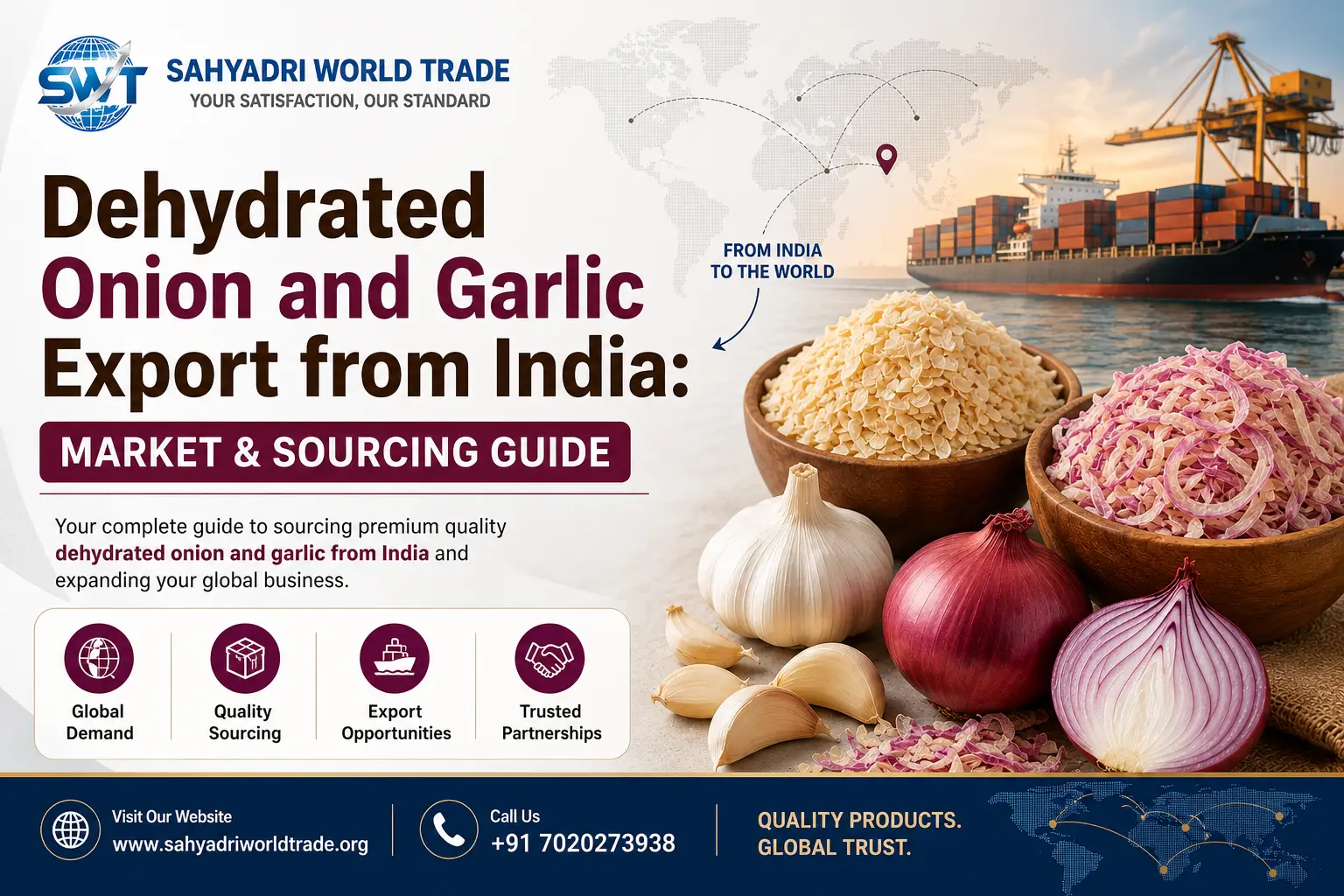
Dehydrated Onion and Garlic Export from India: Market & Sourcing Guide
India offers a broad agricultural and food-processing ecosystem for buyers looking for dehydrated onions, garlic, spices, and other processed ingredients. Available forms can include flakes, minced products, granules, and powders, depending on the application and processor.
This guide explains what international buyers should know before sourcing dehydrated onion and garlic from India, including product forms, processing, quality checks, packaging, compliance, export logistics, and supplier selection.
What Are Dehydrated Onions and Garlic?
Dehydrated onions and garlic are processed ingredients produced by removing much of the moisture from fresh produce through controlled dehydration.
Instead of shipping a highly perishable fresh ingredient, buyers can source a more convenient ingredient in formats such as:
- Onion flakes
- Onion slices
- Minced onion
- Onion granules
- Onion powder
- Garlic flakes
- Garlic slices
- Minced garlic
- Garlic granules
- Garlic powder
The processing chain generally moves from raw material preparation to cutting, dehydration, cooling, grading, milling or sieving where required, and final packaging.
For commercial buyers, the important distinction is that these are not interchangeable products. Particle size, moisture, appearance, aroma, application, and packaging can all affect whether a particular product is suitable for manufacturing.
Why Use Dehydrated Onion and Garlic Instead of Fresh Produce?
Fresh onion and garlic remain important agricultural commodities, but processed ingredients solve different supply-chain problems.
Dehydrated products can offer:
Convenience: The buyer can use the ingredient without the preparation associated with peeling, chopping, or handling fresh produce.
Storage practicality: Moisture reduction can make the ingredient easier to store when the product is correctly packaged and stored.
Manufacturing consistency: A defined particle size and product specification can make recipe standardization easier.
Reduced preparation waste: Food manufacturers and foodservice operations can use the quantity needed without processing large volumes of fresh produce.
Broader applications: Dehydrated ingredients can be used in seasonings, soups, sauces, instant foods, snack products, spice mixes, ready-to-eat meals, and other processed-food applications.
The commercial advantage, however, depends on the processor maintaining the agreed specification from batch to batch.
Dehydrated Onions: Flakes, Minced, Granules or Powder?
The correct format depends on how the ingredient will be used.
Dehydrated onion flakes or slices may be preferred where visible onion pieces and texture are required.
Minced dehydrated onion provides a smaller particle format for prepared foods, sauces, fillings, and blended products.
Onion granules can be suitable for seasoning applications where a more uniform particle is preferred.
Powdered onion can be useful when the ingredient needs to disperse more evenly through a formulation. It is often relevant to seasoning blends, sauces, soups, spice products, instant foods, and other industrial recipes.
A buyer should therefore avoid sending an enquiry that only says "dehydrated onion." A stronger specification identifies the required form, particle size, moisture, packaging, quantity, shelf life, testing, and intended application.
How to Make Onion Powder for Commercial Food Use
The query how to make onion powder sounds simple, but commercial production involves considerably more than drying onion and grinding it.
A typical industrial sequence is:
Fresh onion → cleaning and preparation → slicing or cutting → controlled dehydration → cooling → milling → sieving → packaging.
The purpose of controlled dehydration is to reduce moisture while maintaining a product that can be processed into the required powder specification.
Once the dehydrated onion is sufficiently dry and conditioned, it can be milled to the required particle size. Sieving helps create a more consistent finished product.
For buyers, the more useful questions are therefore not only "how to make onion powder," but also:
- What moisture specification is maintained?
- What particle size is supplied?
- How is foreign matter controlled?
- Is batch testing available?
- How is the product protected from moisture after processing?
- Can the same specification be maintained for repeat orders?
That shift from recipe-level curiosity to specification-level sourcing is important for B2B procurement.
Garlic Flakes and Other Dehydrated Garlic Forms
Garlic flakes are one of several commercially available forms of dehydrated garlic. Depending on the application, buyers may also require slices, minced garlic, granules, or powder.
Flakes can work for food applications where the buyer wants visible pieces or a larger particle size. Granules can support seasoning and blending applications, while powder is useful when uniform distribution is required.
The selection should be linked to the end use rather than made purely on price. Food manufacturers may also require specific controls for aroma, colour, particle size, moisture, purity, and microbiological quality.
How to Make Garlic Powder at Industrial Scale
Anyone researching how to make garlic powder will find that industrial production begins with properly prepared garlic.
A typical process includes:
Cleaning → peeling → separation → slicing or cutting → dehydration → cooling → milling → sieving → packaging.
The final powder must then be assessed against the agreed commercial specification.
For an importer, this means that processing capability should be evaluated together with the finished product. A supplier may have access to garlic, but that does not automatically mean it can consistently supply the particle size, moisture, aroma, packaging, testing, and documentation required by a food manufacturer.
Why India Is a Practical Sourcing Base
India's agricultural and processing ecosystem extends across multiple regions. For a buyer, this creates an important distinction:
Farm origin is not necessarily the same as processing location, exporter location, or shipping location.
Sourcing and processing networks can involve regions including Maharashtra, Gujarat, Madhya Pradesh, Rajasthan, Karnataka, Uttar Pradesh, and other agricultural belts.
This regional diversity can matter when availability changes seasonally or when buyers need larger or repeat quantities.
For international sourcing, an exporter with access to multiple supplier networks can potentially reduce dependence on one source. The buyer should still verify actual supply capacity, processor capability, product specifications, and documentation for the specific order.
Who Buys Dehydrated Onion and Garlic from India?
The market includes several different buyer types.
Importers may prioritize pricing, documentation, shipping coordination, and dependable supply.
Food manufacturers typically focus on product consistency, moisture, particle size, flavour, colour, microbiological parameters, and batch uniformity.
Spice and seasoning manufacturers may prefer granules or powders that blend consistently.
Foodservice distributors can value convenience, shelf stability, and reduced preparation.
Wholesale and private-label buyers may require bulk packaging, customized labels, repeat availability, and commercial flexibility.
The broader international market includes buyers across North America, Europe, the Middle East, and Asia-Pacific, although specific import requirements vary by destination.
What Quality Specifications Should Buyers Check?
A professional sourcing enquiry should define measurable product requirements.
Relevant parameters may include:
- Moisture content
- Particle size
- Colour
- Aroma
- Flavour
- Purity
- Foreign matter
- Microbiological parameters
- Pesticide residues where applicable
- Additives or preservatives where applicable
- Water activity where relevant
- Shelf life
- Batch consistency
- Packaging integrity
These requirements should be agreed according to the product, application, buyer specification, and destination-market requirements.
Laboratory analysis can also be arranged where required by the buyer or destination market. Depending on the product, tests may cover moisture, microbiological parameters, pesticide residues, heavy metals, purity, or other product-specific criteria.
For a serious importer, a batch-specific Certificate of Analysis can be a useful part of the approval process.
Packaging for Bulk Dehydrated Onion and Garlic
Correct packaging is essential because dried products can still be affected by moisture exposure.
Depending on the product and commercial requirement, packaging may include food-grade bags, inner liners, multiwall paper bags, cartons, bulk sacks, or other moisture-resistant configurations.
Before confirming an order, buyers should establish:
- Net weight per package
- Inner liner requirements
- Moisture protection
- Outer packaging
- Label format
- Batch identification
- Packing date
- Shelf-life information
- Palletization requirements
For qualifying commercial programmes, packaging can also be customized for buyer branding, country-of-origin information, barcodes, product specifications, and handling instructions.
Export Documentation and Food Compliance
Export documentation depends on the product and importing country.
Common shipment documentation can include a Commercial Invoice, Packing List, Shipping Bill, Bill of Lading, Certificate of Origin, and other certificates or reports where applicable.
Depending on the product and destination, buyers may encounter requirements involving IEC, APEDA-related registration, FSSAI requirements, phytosanitary documentation, fumigation documentation, laboratory testing, or food-safety certifications.
It is also important to distinguish compulsory shipment or regulatory documentation from voluntary certifications. HACCP, ISO 22000, FSSC 22000, BRCGS, Halal, Kosher, and organic certification do not automatically apply to every product or every shipment. The applicable requirement should be checked for the exact product and market.
How to Choose a Dehydrated Onion and Garlic Supplier in India
Do not compare suppliers only by quoted price.
A better supplier-evaluation process should consider:
- Product form and particle size
- Moisture specification
- Purity and quality requirements
- Available quantity and MOQ
- Packaging capability
- Shelf-life information
- Laboratory testing or COA availability
- Lot and batch traceability
- Export documentation
- Pre-shipment inspection
- Shipment coordination
- Ability to maintain the same specification for repeat orders
A strong commercial supplier should also be able to understand what the buyer actually needs rather than simply offering whatever stock is available.
Sahyadri World Trade's sourcing process is designed around this requirement-first approach. Its stated practices include supplier selection, product inspection, packaging coordination, documentation support, shipment planning, and quality checks against agreed buyer specifications. The company can handle trial requirements as well as larger commercial quantities depending on availability, destination requirements, and seasonal conditions.
Common Problems When Sourcing Dehydrated Ingredients
International buyers can face issues such as inconsistent moisture, different particle sizes, colour variation, weak aroma, contamination risks, foreign matter, poor packaging, documentation problems, shipment delays, and unreliable repeat supply.
The simplest way to reduce these risks is to define the specification before procurement.
That specification should cover the product form, quality parameters, packaging, testing, documentation, quantity, destination, and shipping expectations.
Pre-shipment checks can then verify quantity, grade, packaging condition, labels, batch identification, gross and net weight, visible product condition, and compliance with the buyer's agreed specification.
Photographs from packing and loading can also provide a useful record of the shipment.
Trial Orders Can Reduce Sourcing Risk
For a new supplier relationship, a trial order can provide useful evidence before moving to larger volumes.
The trial can reveal how well the supplier performs across more than product quality. Buyers can assess communication, documentation, packaging, inspection, shipment coordination, and overall responsiveness.
Once the buyer approves the product, the specification can be recorded for future orders, including product form, particle size, packaging, quantity, labeling, inspection requirements, shipping method, and documentation.
This creates a more repeatable procurement process and reduces the chance of specifications changing from one shipment to the next.
Why Supplier Process Matters as Much as Product
A dehydrated ingredient may look acceptable at quotation stage but still create problems later if the supply process is poorly controlled.
The useful questions are therefore:
Where is the product sourced?
Who processes it?
What specification is being followed?
How is quality checked?
What documentation accompanies the shipment?
How is the packed product protected during transport?
Can the supplier reproduce the same specification next month?
For buyers looking for dehydrated onion exporters in India, dehydrated garlic suppliers, or bulk ingredient sourcing support, these questions provide a better basis for comparison than price alone.
Start With a Clear Sourcing Specification
A good import enquiry should include the product name, form, required quantity, preferred particle size, moisture requirement, packaging, destination port, testing requirements, documentation needs, and expected shipment schedule.
The clearer the requirement, the easier it becomes for a sourcing partner to identify the right supplier and avoid unnecessary back-and-forth.
Sahyadri World Trade can coordinate Indian sourcing, supplier identification, quality inspection, packaging, export documentation, and shipment planning based on the buyer's commercial requirements.
For a first enquiry, buyers can begin with a trial quantity and use the first shipment to evaluate product performance, packaging, communication, and execution before establishing a repeat-order specification.
Frequently Asked Questions
What are dehydrated onions used for?
Dehydrated onions can be used in soups, sauces, seasoning blends, spice mixes, snack foods, instant foods, ready-to-eat meals, and foodservice applications.
What is powdered onion?
Powdered onion is dehydrated onion that has been milled into a fine particle format. It can be used where even distribution is required, including seasonings, sauces, soups, spice blends, and other processed foods.
What are garlic flakes used for?
Garlic flakes are dehydrated garlic pieces that can be incorporated into prepared foods, seasoning systems, sauces, recipes, and other applications where a larger dried garlic particle is preferred.
How do I choose a dehydrated onion supplier in India?
Check the supplier's product specifications, moisture and particle-size controls, packaging, testing capability, documentation, traceability, inspection process, and ability to support repeat orders.
Can dehydrated onion and garlic be purchased in bulk for export?
Yes. Bulk sourcing can be arranged according to product availability, buyer specifications, packaging requirements, destination regulations, and shipment planning.
How can I check quality before shipment?
Agree a written product specification, then use sampling, inspection, laboratory testing where required, packaging checks, quantity verification, and pre-shipment records to confirm compliance.
How can I request a quotation from an Indian supplier?
Send the supplier the required product form, quantity, quality specification, packaging preference, destination country or port, testing requirements, and desired shipment schedule. This gives the exporter enough information to prepare a more relevant commercial response.