- Utkarsh Urvashi CHS, 1st Floor, Veshvi, Alibag
- info@sahyadriworldtrade.com
- Open: Mon–Sat: 08:00 – 18:00

Fresh Paneer vs Processed Cheese: What Is the Difference?
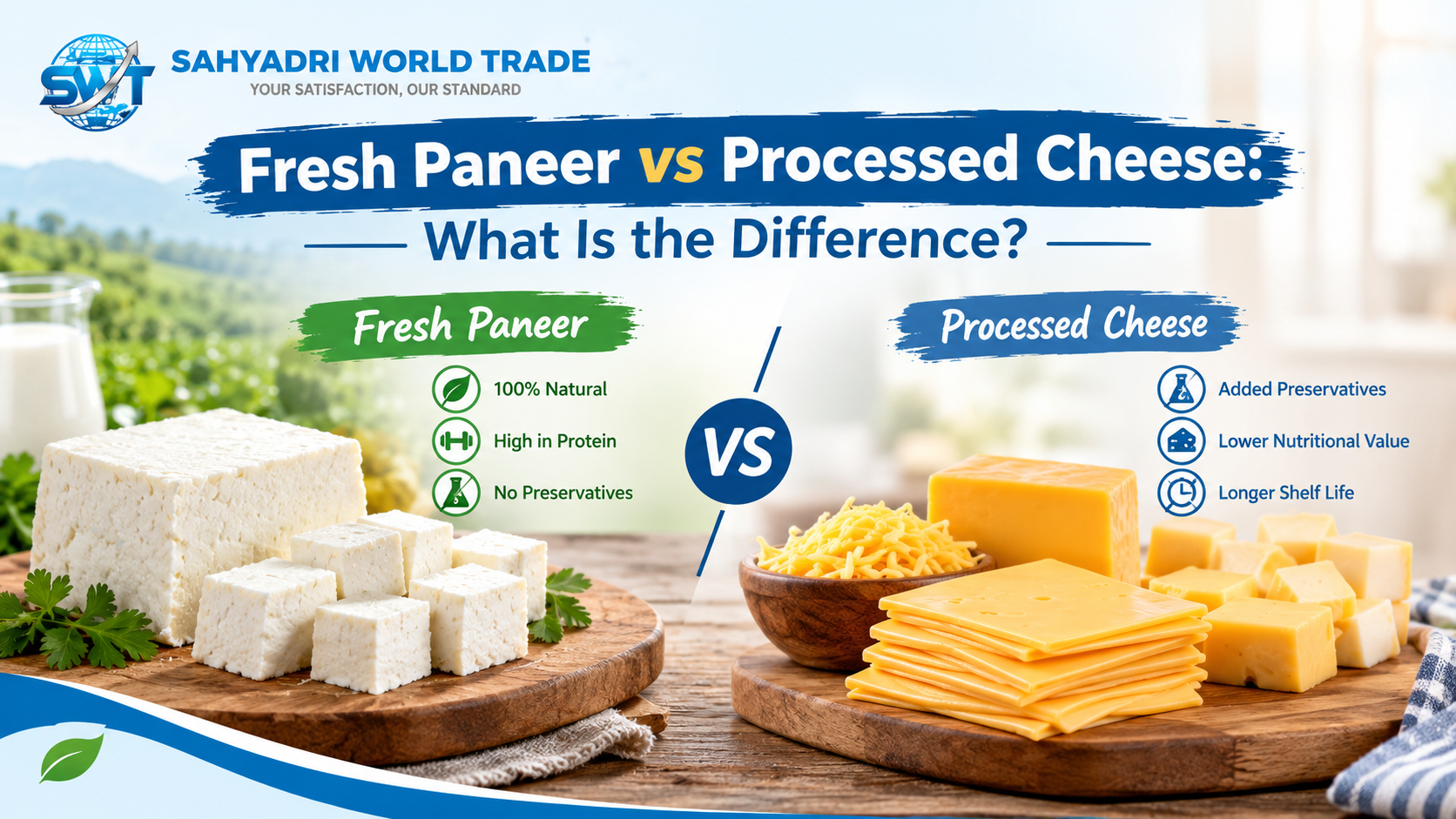
Fresh Paneer vs Processed Cheese: What Is the Difference?
The practical difference is simple: Indian paneer is firm and shape-holding, while processed cheese is designed to soften and melt. The better choice depends on how you plan to use it, from home cooking to restaurant and foodservice applications.
What Is Fresh Paneer?
Fresh paneer is a fresh, pressed dairy product traditionally made by acid-coagulating milk. An appropriate food acidifying agent causes the milk proteins to form curds. The curds are separated from the whey, collected, pressed, and chilled into a firm block.
This process gives Indian paneer its distinctive characteristics: a mild, milky flavor, dense texture, and ability to be sliced or cut into cubes. Unlike aged cheeses, paneer is generally consumed fresh rather than matured over an extended period.
Paneer is widely used in dishes such as palak paneer, paneer tikka, paneer butter masala, wraps, grilled appetizers, and vegetarian entrées.
Is Paneer the Same as Indian Cottage Cheese?
Paneer is sometimes marketed or described in the U.S. as Indian cottage cheese, but that name can be misleading.
Traditional cottage cheese has loose, moist curds, while paneer consists of coagulated milk curds that have been pressed into a cohesive block. They therefore behave differently in cooking and have distinctly different textures.
So, while “Indian cottage cheese” can help U.S. consumers identify paneer, it should not be interpreted as conventional American cottage cheese.
What Is Processed Cheese?
Processed cheese is manufactured by blending cheese with selected dairy ingredients and functional ingredients such as emulsifying salts, followed by controlled heating and mixing.
The purpose is to create a consistent product with controlled moisture, texture, flavor, and melting characteristics. Depending on the formulation, processed cheese may be sold as slices, blocks, spreads, sauces, or other formats.
This makes processed cheese particularly useful in burgers, sandwiches, dips, sauces, and other applications where a smooth and predictable melt is important.
Fresh Paneer vs Processed Cheese: The Key Difference
The biggest difference becomes obvious when both products are heated.
Fresh paneer generally holds its shape. Processed cheese generally melts and flows.
Paneer's structure is created through coagulation and pressing. Its protein network remains sufficiently firm during cooking to keep the piece together. It may soften, brown, or develop a firmer exterior, but it normally does not turn into the smooth melted layer associated with processed cheese.
Processed cheese is formulated differently. Emulsification helps maintain a stable distribution of fat, water, and cheese components during heating, giving it the smooth consistency expected from a melting cheese product.
That difference is not a defect in either product. It reflects what each product is designed to do.
Why Doesn't Fresh Paneer Melt Like Cheese?
The question “Does paneer melt?” has a surprisingly useful answer: generally, no.
Fresh paneer develops a firm protein structure during coagulation and pressing. When heated, that structure typically remains intact rather than flowing into a liquid mass.
This makes paneer especially useful for applications where pieces need to survive cooking. Cubes can be grilled, fried, sautéed, or incorporated into curries without completely disappearing.
Processed cheese has a formulation intended to promote smooth melting, which is why it performs differently in hot sandwiches, sauces, burgers, and dips.
Indian Paneer vs Processed Cheese for Cooking
Neither product is automatically better. The right choice depends on the application.
Choose Indian paneer when you want a firm, substantial dairy ingredient that can be grilled, pan-fried, baked, sautéed, or added to curries. It is particularly useful for vegetarian dishes in which the cheese needs to remain recognizable after cooking.
Choose processed cheese when you need a creamy, spreadable or smoothly melted ingredient. It is generally more suitable for burgers, grilled sandwiches, cheese sauces, dips, and similar applications.
For example, replacing paneer with processed cheese in paneer tikka would fundamentally change the dish because the cheese would no longer provide the same firm texture.
Is Fresh Paneer Healthier Than Processed Cheese?
There is no universal answer.
Fresh paneer can provide protein, calcium, and fat, but its nutritional profile depends on the milk and manufacturing process. Processed cheese can also provide protein and calcium, while sodium, fat, carbohydrate, and calorie levels vary among formulations.
Rather than assuming that fresh automatically means healthier, compare the Nutrition Facts panel, ingredient list, serving size, protein, saturated fat, sodium, and calcium content of the specific products.
This distinction matters particularly for restaurants and foodservice operators that need to balance nutrition, taste, portion size, and customer preferences.
Fresh Paneer Storage and Food Safety
Unlike many shelf-stable processed products, fresh paneer is a perishable refrigerated dairy product. Product quality depends on hygienic manufacture, appropriate packaging, refrigeration, and proper handling throughout storage and transportation.
Shelf life varies according to the product, packaging, processing method, and storage conditions. Buyers should therefore follow the manufacturer's stated temperature and date requirements rather than relying on a generic shelf-life assumption.
For commercial purchasing, cold-chain continuity, packaging integrity, batch identification, labeling, and destination-market food requirements should all be considered before shipment.
What Should Restaurants Look for in Paneer for Wholesale?
For restaurants, caterers, distributors, and retailers, choosing paneer for wholesale involves more than finding a low price.
A commercial buyer may need consistent block size, weight, texture, packaging, shelf life, and batch performance. Recurring buyers may also need predictable supply, buyer-specific specifications, clear documentation, and dependable refrigerated handling.
Questions worth asking a supplier include:
- Can the supplier maintain consistent specifications between shipments?
- What packaging formats are available?
- What are the applicable storage and transportation requirements?
- Can recurring commercial quantities be supported?
- Can packaging or labeling be customized?
- How are quality checks and shipment records maintained?
These factors become especially important when paneer is being used across multiple restaurant locations or distributed to foodservice customers.
Choosing a Bulk Paneer Supplier
A bulk paneer supplier should be able to discuss your actual procurement requirements before simply quoting a product.
For international buyers, those requirements can include product specification, quantity, packaging format, destination market, labeling, documentation, expected shipment schedule, and temperature-control needs.
A supplier's ability to coordinate these details can be just as important as the paneer's taste. In commercial sourcing, inconsistent quality, unsuitable packaging, unclear documentation, or weak communication can create much larger costs than a small difference in the initial purchase price.
Sahyadri World Trade approaches food sourcing through buyer-defined requirements, supplier coordination, pre-shipment checks, packaging coordination, documentation, and shipment planning. For suitable dairy requirements, buyers can discuss specifications and commercial quantities based on destination and product availability.
The objective is not simply to locate Indian paneer, but to coordinate a sourcing process around what the buyer actually needs.
Which One Should You Choose?
For consumers, the decision comes down to cooking behavior.
Choose fresh paneer when you want firm pieces that retain their shape during cooking. Choose processed cheese when you need smooth melting, spreading, or a creamy sauce.
For restaurants, wholesalers, caterers, and distributors, the decision also involves supply reliability, packaging, shelf life, refrigerated handling, consistency, and purchasing volume.
When sourcing paneer for wholesale, a clear specification before procurement can help reduce misunderstandings and make repeat orders easier to manage. Buyers can provide their required quantity, preferred packaging, destination, product expectations, and shipment schedule so a suitable sourcing option can be evaluated.
FAQs
Is Indian paneer the same as Indian cottage cheese?
Paneer is often called Indian cottage cheese, particularly for U.S. audiences, but the products are not the same. Paneer is pressed into a firm block, while conventional cottage cheese has loose curds.
Does fresh paneer melt?
Fresh paneer generally does not melt into a flowing mass. It typically softens, browns, or firms when heated while retaining its shape.
Is processed cheese the same as paneer?
No. Paneer is a fresh, pressed dairy product, while processed cheese is formulated and heat-treated to provide controlled texture and melting performance.
Is fresh paneer healthier than processed cheese?
Not necessarily. Nutritional values vary between products. Compare the specific ingredient list and Nutrition Facts panel for protein, fat, saturated fat, sodium, calcium, and calories.
Can processed cheese replace Indian paneer?
Usually not as a direct substitute. Processed cheese melts and has a different texture, so replacing paneer will change the cooking result.
How should fresh paneer be stored?
Fresh paneer should be kept refrigerated according to the manufacturer's storage instructions. Commercial buyers should also consider cold-chain requirements during transportation and distribution.
Can I buy paneer for wholesale or in bulk?
Yes. Restaurants, distributors, caterers, retailers, and other commercial buyers can source paneer in bulk, subject to product availability, specifications, packaging, destination requirements, and commercial terms.