- Utkarsh Urvashi CHS, 1st Floor, Veshvi, Alibag
- info@sahyadriworldtrade.com
- Open: Mon–Sat: 08:00 – 18:00

Fresh Vegetable Export from India: Quality, Packaging and Shipping Guide
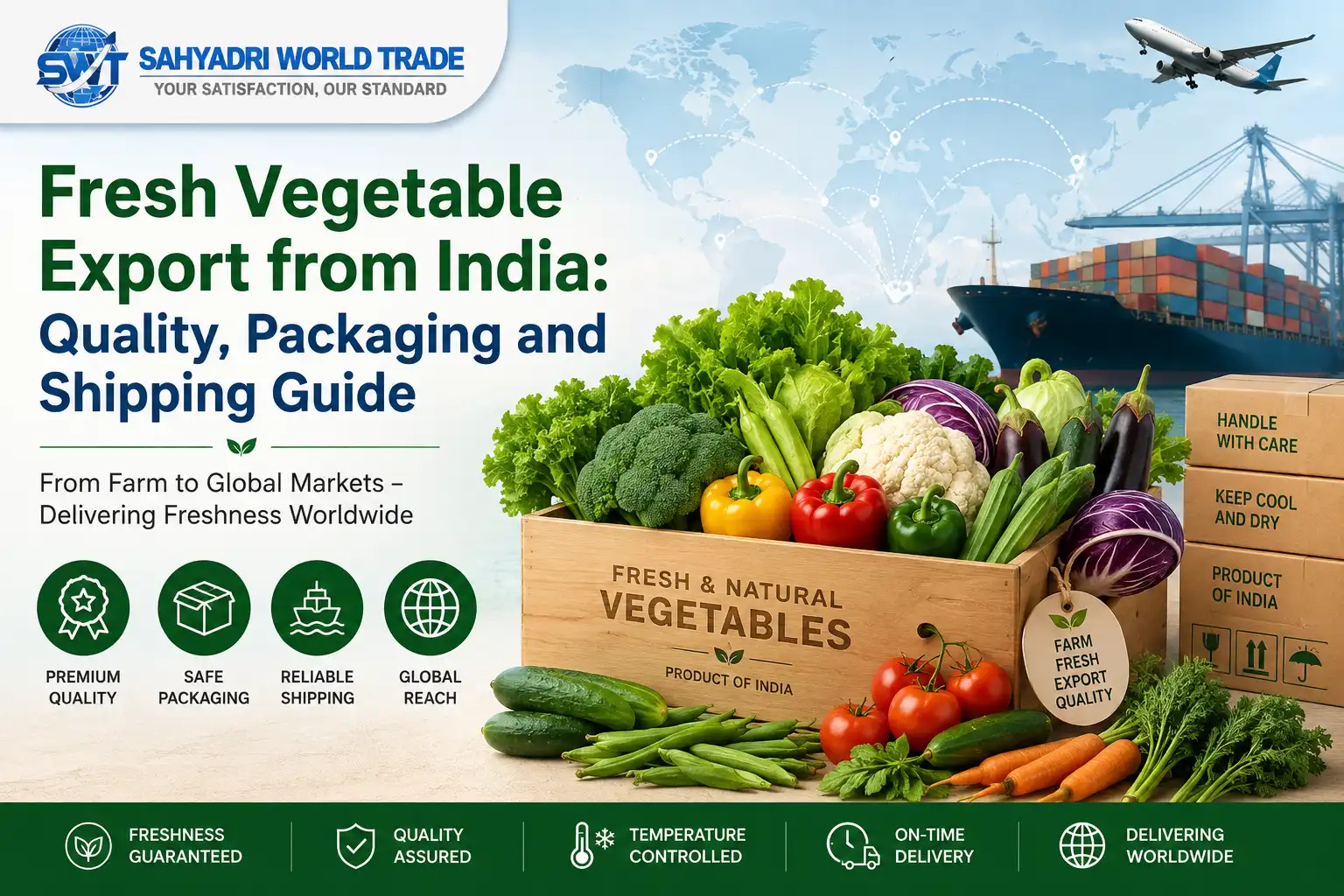
Fresh Vegetable Export from India: Quality, Packaging and Shipping Guide
This is why successful fresh vegetable export from India starts with a written specification, not a general promise of “export quality.” Importers need clarity about grades, packaging, inspection, documents, shipping conditions, and responsibilities before the produce is sourced.
This guide explains how importers, wholesalers, distributors, retailers, food-service businesses, and processors can reduce sourcing risks and prepare a commercially useful enquiry.
Why buyers source vegetables from India
India offers a wide agricultural base and access to products such as onion, potato, tomato, green chilli, ginger, garlic, okra, drumstick, yam, cabbage, cauliflower, carrot, beetroot, bottle gourd, bitter gourd, cucumber, green peas, and sweet corn. Buyers can also source frozen mixed vegetables and processed products such as dehydrated onion and garlic.
Availability, however, does not mean every product is offered in every grade throughout the year. Crop cycles, weather, market arrivals, domestic demand, export restrictions, supplier capacity, and freight availability can change the commercial situation. A reliable exporter should confirm the current lot, specification, quantity, and shipping feasibility before issuing a final offer.
Define the vegetable specification before requesting a price
A request such as “quote one container of onions” is too broad for accurate pricing. One supplier may quote small mixed-grade bulbs in basic packaging, while another prices sorted large onions in stronger mesh bags. The offers cannot be compared fairly because they describe different products.
A complete request for quotation should include:
- product name and variety, when relevant
- fresh, frozen, or dehydrated form
- grade and required size range
- color, maturity, firmness, and moisture condition
- permitted levels of damage, decay, sprouting, bruising, or foreign matter
- total quantity and preferred pack weight
- packaging material, ventilation, labels, and private-label needs
- destination country, port, and final delivery point
- preferred shipping method and required delivery window
- temperature or cold-chain instructions
- required tests, certificates, and inspection method
- preferred Incoterm and payment expectations
Consider an illustrative order for 20 metric tons of Indian red onions in 25 kg mesh bags. The buyer should define more than the bag weight. The specification should cover bulb diameter, dryness, firmness, skin condition, visible damage, sprouting tolerance, net-weight tolerance, bag strength, labeling, inspection, and documentation.
Once these details are agreed, the sourcing team can select and grade the lot against a measurable target. Without them, disagreements are likely to appear when correcting the shipment is most expensive.
How vegetable quality should be checked before export
Quality control is a sequence, not a quick look at the top layer of one bag. It should begin with the source and continue through grading, packing, inspection, and loading.
Fresh produce may be checked for size consistency, color, maturity, firmness, physical damage, pest damage, decay, sprouting, moisture, cleanliness, and foreign matter. Processed products need different controls, including cut size, moisture, seal integrity, batch identification, net weight, shelf-life information, and relevant microbiological or chemical parameters.
Sample from different parts of the lot
Inspecting one package cannot represent a container-scale order. Samples should be selected from different sections of the lot according to an agreed plan. For a large onion consignment, the inspection may compare average bulb size, damage, rot, sprouting, surface moisture, skin condition, and packaging strength.
If the samples show unacceptable variation, the lot can be re-sorted, repacked, or rejected before dispatch. This is more practical than debating quality after the goods reach the destination.
Arrange laboratory tests when required
Visual inspection cannot confirm pesticide residue levels, heavy metals, or microbiological safety. Testing may be required by the destination authority, importer, retailer, or buyer specification. The parties should agree on the tested parameters, applicable limits, sampling responsibility, laboratory acceptability, and report timing.
Countries can apply sanitary and phytosanitary measures covering food safety, plant health, residue limits, inspection, and treatment. The World Trade Organization's SPS overview explains the international framework, but the exact current requirement must be checked for the product and destination.
Maintain traceability and shipment evidence
A shipment record can include the supplier, lot number, procurement date, packing date, quantity, packaging, inspection findings, test reports, container number, seal number, and loading photographs. These records help identify the affected batch and investigate the cause if the buyer reports damage or non-conformity.
Choose packaging according to the product
Export packaging must contain the product, protect it from physical damage, and provide the ventilation or moisture control it needs. The strongest carton is not automatically the best choice if it blocks airflow. Excessive ventilation can also weaken a carton or increase moisture loss.
Dry onions are commonly packed in ventilated mesh bags. Commercial options may include 5, 10, 20, 25, or 50 kg, depending on buyer requirements and handling conditions. The bag must allow air circulation while withstanding lifting, stacking, and transport.
Fresh green chillies may be packed in ventilated corrugated cartons or suitable crates. Smaller pack weights can reduce pressure damage. Products should be sorted to remove overripe, damaged, or discolored chillies before packing.
Ginger may move in cartons or mesh bags selected according to the route and buyer preference. Inspection should cover rhizome size, firmness, moisture, sprouting, decay, and surface damage.
Tomatoes, okra, drumsticks, cucumbers, gourds, cabbage, and cauliflower need packaging designed around their individual sensitivity to pressure, water loss, heat, and breakage. Dehydrated onion and garlic require sealed food-grade inner packaging that protects against moisture and contamination, supported by suitable outer packaging.
Private-label packaging may be possible for suitable products and quantities. Buyers should approve artwork, product identity, net quantity, country-of-origin wording, barcode, batch coding, handling marks, and legally required destination information before printing.
Select the right shipping method
The correct shipping method depends on shelf life, shipment volume, transit time, landed cost, route reliability, and temperature sensitivity.
Air freight is useful for samples, urgent orders, smaller quantities, or highly perishable products that can support the higher cost. Sea freight is normally more economical for larger commercial volumes, but the longer transit increases the importance of product condition, packaging, route planning, and temperature management.
Full Container Load (FCL) provides greater control over a container-scale shipment and reduces handling by other cargo interests. Less than Container Load (LCL) can support smaller quantities, but consolidation may add handling, delay, and compatibility concerns. Not every LCL service is suitable for fresh produce.
Dry containers may work for commodities and routes proven suitable without active refrigeration. Reefer containers provide controlled temperature and airflow, but they cannot repair warm, overripe, damaged, or poorly packed produce.
Temperature settings must be product-specific. Pre-cooling, loading time, airflow, humidity, ventilation, and monitoring can be as important as the set point. Mixed loads also require care
Confirm export documents and destination requirements
Document requirements change according to the commodity, destination, processing state, shipment method, and Incoterm. Common records may include a commercial invoice, packing list, shipping bill, bill of lading or air waybill, and certificate of origin. A phytosanitary certificate, fumigation certificate, laboratory report, inspection certificate, or insurance certificate may also be required.
India's Directorate General of Foreign Trade describes the Importer-Exporter Code (IEC) as a key business identification number for imports and exports. APEDA's HortiNet service supports certification and traceability processes for several horticultural products. These registrations and systems should not be presented as proof that every supplier, facility, or shipment holds every certification a buyer requests.
Importers must check current destination rules before procurement:
- The European Commission explains plant-health controls for products entering the European Union from non-EU countries.
- Great Britain classifies plant products by risk. Its current import guidance covers registration, notification, phytosanitary, inspection, quality, and labeling requirements.
- For the United States, admissibility depends on the commodity and country of origin. USDA APHIS directs buyers to its commodity import-requirements database. Covered food importers may also have responsibilities under the FDA's Foreign Supplier Verification Programs rule.
Requirements for Gulf, Asian, Canadian, Australian, New Zealand, and African markets should likewise be confirmed with the relevant authority and importer. Rules can differ even for two vegetables shipped to the same country.
How to import vegetables from India with fewer surprises
Start by confirming that the exact commodity and Indian origin are admissible in your market. Prepare the quality specification, then send it to potential suppliers with the quantity, packaging, destination, delivery window, and commercial terms.
Evaluate the vegetable export company in India against evidence related to your order. Ask who will supply and pack the product, how the lot will be sampled, which tests can be arranged, what traceability will be maintained, and how loading will be recorded. Request current lot photographs or a sample when practical.
Before dispatch, approve the packaging, labels, route, container plan, documents, inspection procedure, and claims process. Ensure your customs broker, plant-health agent, warehouse, and onward transport provider are prepared before the shipment arrives.
Build a repeatable supply arrangement
After a successful trial shipment, the agreed grade, tolerances, packaging, labels, inspection method, and shipping instructions can become the starting point for repeat orders. Current availability and compliance still need to be checked, but a recorded specification reduces misunderstandings and speeds up future procurement.
Sahyadri World Trade coordinates Indian product sourcing, quality checks, packaging, documentation, and shipment planning for international buyers. Its fresh-produce range includes onion, green chilli, ginger, drumstick, yam, and other products, subject to current availability and destination feasibility.
To request an actionable quotation, share the product, grade, size, quantity, packaging, destination port, preferred Incoterm, shipment schedule, and required tests or certificates. Contact Sahyadri World Trade at info@sahyadriworldtrade.com or +91 7020273938.
Frequently Asked Questions
What vegetables can be exported from India?
Potential products include onion, potato, tomato, green chilli, ginger, garlic, okra, drumstick, yam, cabbage, cauliflower, carrots, gourds, cucumber, peas, sweet corn, and processed vegetable products. Feasibility depends on availability, destination rules, quality, and logistics.
What is the minimum order quantity?
MOQ varies by product, packaging, route, and shipment mode. Ask for separate trial-order and commercial-volume options. Small shipments may have a higher landed cost per kilogram.
Can buyers request customized or private-label packaging?
Yes, when the product, quantity, packaging supplier, and schedule make it practical. Artwork, labels, barcodes, batch information, and destination requirements should be approved before production.
Is a reefer container required for every vegetable?
No. The decision depends on the commodity, transit time, initial condition, climate exposure, and validated storage requirements. A product-specific shipping assessment is essential.
Which documents are normally supplied?
Typical documents include a commercial invoice, packing list, shipping bill, transport document, and certificate of origin. Plant-health, testing, treatment, inspection, or insurance documents may be required for a specific shipment.
Can an exporter quote FOB, CFR, CIF, or EXW?
These terms may be quoted depending on the exporter's service scope. The quotation should state the named place or port, Incoterms edition, currency, validity, inclusions, and exclusions.
Can buyers receive samples before ordering?
Samples may be possible depending on the vegetable, destination admissibility, and air-cargo or courier rules. For highly perishable products, live video inspection, third-party inspection, or a small trial shipment may provide better evidence.