- Utkarsh Urvashi CHS, 1st Floor, Veshvi, Alibag
- info@sahyadriworldtrade.com
- Open: Mon–Sat: 08:00 – 18:00

Green Chilli Export from India: Top Markets, Buyers & Export Requirements
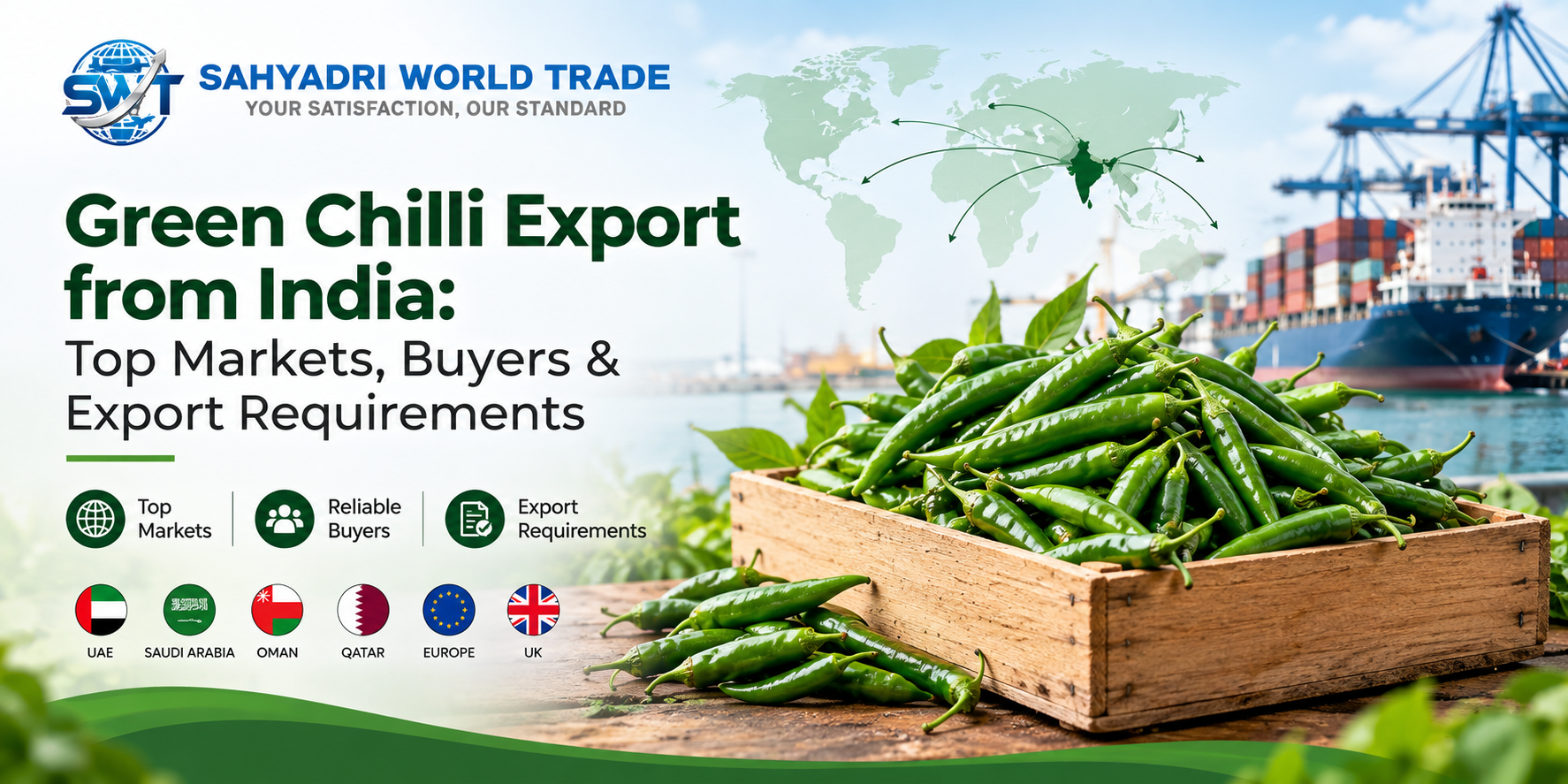
Green Chilli Export from India: Top Markets, Buyers & Export Requirements
India has a broad sourcing base for fresh produce, with green chilli cultivated and traded across states including Andhra Pradesh, Telangana, Karnataka, Maharashtra, Gujarat, Madhya Pradesh and Tamil Nadu. Buyers can source through an Indian green chilli exporter that coordinates sorting, grading, packing, documentation and shipment according to agreed specifications.
This guide explains how green chilli export from India works, where demand comes from, what U.S. buyers should check, and how to evaluate green chilli suppliers.
Why Do Buyers Source Green Chilli from India?
Indian green chilli is used by wholesalers, restaurants, foodservice operators, retailers, distributors and food businesses needing fresh chilli peppers for cooking and ingredient supply.
A buyer may specify variety, colour, length, firmness, maturity, defect tolerance, packing size and expected shelf life. Export-quality green chilli is therefore not simply about appearance at harvest. It is about matching the shipment to a commercial specification and protecting chilli freshness through handling and transit.
India's multi-region production base also gives buyers options as seasonal availability changes.
Top Markets for Indian Green Chilli
India supplies fresh agricultural products to multiple international markets, with demand across the Middle East, United Kingdom, North America and other destinations. Exact opportunities vary with season, freight conditions, buyer specifications and importing-country rules.
For exporters, the United States is a relevant market for green chilli importers USA, wholesalers, ethnic grocery distributors, restaurant suppliers and foodservice produce suppliers. Distribution networks in states such as California, New York, New Jersey, Texas, Florida and Illinois can be relevant, although the actual buyer may be located elsewhere.
Green Chilli Buyers in the USA: What They Need
U.S. buyers may purchase through an importer, produce distributor, wholesaler or directly from an overseas supplier. Before requesting a quotation, define:
- chilli variety and preferred specifications
- size, length, colour and maturity
- acceptable defect tolerance
- quantity or MOQ
- carton or crate format and net weight
- destination port or delivery point
- required delivery schedule
- testing, traceability and documentation needs
Clear specifications reduce the risk of receiving produce that is fresh but commercially unsuitable.
How Is Green Chilli Exported from India?
The green chilli export process generally follows sourcing, sorting, grading, inspection, export packaging, documentation, transport and shipment.
Fresh green chilli is selected against buyer requirements. Damaged, discoloured, overripe or otherwise unsuitable pods can be removed during sorting. Grading creates a more consistent lot.
For international shipments, packaging must balance protection, ventilation and handling. Ventilated corrugated cartons or suitable food-grade crates may be used, with pack sizes set by the order. Packaging should match the transport method and destination rather than using one format for every market.
How Is Green Chilli Kept Fresh During Transit?
Fresh green chilli has a limited shelf life, so post-harvest handling matters. Depending on the product and transit plan, logistics can include pre-cooling, temperature-controlled storage, refrigerated transportation and reefer shipment.
The correct green chilli cold chain depends on chilli type, maturity, packing, transit time and handling conditions. Buyers should confirm temperature management, expected transit time and the plan for maintaining product condition before placing a commercial order.
A fixed shelf-life promise should be avoided unless it is supported by product-specific evidence and logistics conditions.
What Are the U.S. Import Requirements?
U.S. import requirements can involve several authorities and vary by commodity and shipment. U.S. Food and Drug Administration (FDA) requirements apply to imported food, while USDA Animal and Plant Health Inspection Service (USDA-APHIS) handles plant-health import conditions. U.S. Customs and Border Protection (CBP) handles customs entry and related import processes.
Depending on the shipment, buyers may need to consider:
- FDA food import requirements, including Prior Notice where applicable
- food facility registration requirements where applicable
- USDA-APHIS admissibility and plant-health conditions
- phytosanitary certification where required
- pesticide residue compliance
- labeling and traceability
- customs and commercial documentation
- the responsibilities of the Importer of Record
Admissibility can depend on the exact commodity and entry conditions, so U.S. buyers should verify current requirements in the relevant FDA and USDA-APHIS systems before shipment. Export documents may include a commercial invoice, packing list, shipping bill, bill of lading and certificate of origin, with additional certificates or laboratory reports when applicable.
How to Choose Reliable Green Chilli Suppliers in India
A reliable supplier should be able to discuss specifications before quoting rather than only offering a price.
Ask how suppliers are selected, how lots are sorted and graded, what pre-shipment checks are performed, how packaging is handled, and how documentation is coordinated. For pesticide residue or food-safety concerns, ask whether suitable laboratory testing can be arranged and what traceability records accompany the shipment.
When comparing green chilli exporters in India, Indian green chilli suppliers, fresh chilli suppliers or a bulk green chilli supplier, evaluate consistency, communication, packaging capability, supply capacity and destination-market compliance, not only the quotation.
How to Buy Green Chilli from India
A practical sourcing request should include the product specification, quantity, destination, packing preference, target shipment date and any compliance or testing requirements.
Sahyadri World Trade can support green chilli sourcing from India through its wider sourcing network. Its stated process includes understanding buyer requirements, identifying suitable suppliers, coordinating quality checks, export-ready packaging, documentation and shipment execution.
For buyers, that single point of coordination can be useful when the requirement involves more than simply locating fresh Indian green chilli.
Start a Commercial Green Chilli Sourcing Enquiry
International sourcing works best when supplier and buyer agree on the specification before procurement starts. Share the preferred chilli type, size or grade, quantity, packaging, destination and delivery schedule, and ask the exporter to confirm availability, shipment feasibility and applicable documentation.
Sahyadri World Trade, based in Maharashtra, works with international buyers across fresh produce and other Indian product categories. Buyers seeking a green chilli supplier for USA requirements can contact info@sahyadriworldtrade.com or +91 7020273938 to discuss sourcing, packaging and shipment needs.
FAQs About Green Chilli Export from India
Is green chilli exported from India to the USA?
Yes, Indian fresh produce can be exported to the U.S., but a specific shipment must meet applicable U.S. admissibility, food-safety, plant-health and customs requirements. Buyers should verify current commodity-specific conditions before shipping.
How can I buy fresh green chilli from India?
Provide the required variety or specification, size, quantity, packaging, destination and shipment timeline to a green chilli exporter or supplier. Clear specifications make sourcing and quotations more accurate.
What documents are required to export green chilli?
Common export documents can include a commercial invoice, packing list, shipping bill, bill of lading and certificate of origin. Phytosanitary certificates, inspection documents or laboratory reports may be required depending on the product and destination.
How is fresh green chilli packed for export?
Export packaging can use ventilated corrugated cartons or suitable food-grade crates. Pack size, ventilation and palletization should reflect product condition, handling method and transit requirements.
How long does fresh green chilli last during export?
Shelf life varies with variety, maturity, harvest condition, packing, temperature management and transit time. A fixed number of days should not be promised without product-specific evidence.
What affects green chilli export prices?
Prices can change with seasonality, farm availability, grade, quantity, packaging, testing, freight, exchange rates, destination requirements and shipment timing. A buyer-specific quotation is more useful than a generic market price.
What should U.S. buyers check before choosing a supplier?
Check specification control, sorting and grading, packaging, traceability, quality inspection, documentation capability, shipment coordination, supply capacity and the supplier's ability to meet current U.S. import requirements.