- Utkarsh Urvashi CHS, 1st Floor, Veshvi, Alibag
- info@sahyadriworldtrade.com
- Open: Mon–Sat: 08:00 – 18:00

How Many Bananas Are in 1 Kg? Average Weight, Size & Examples
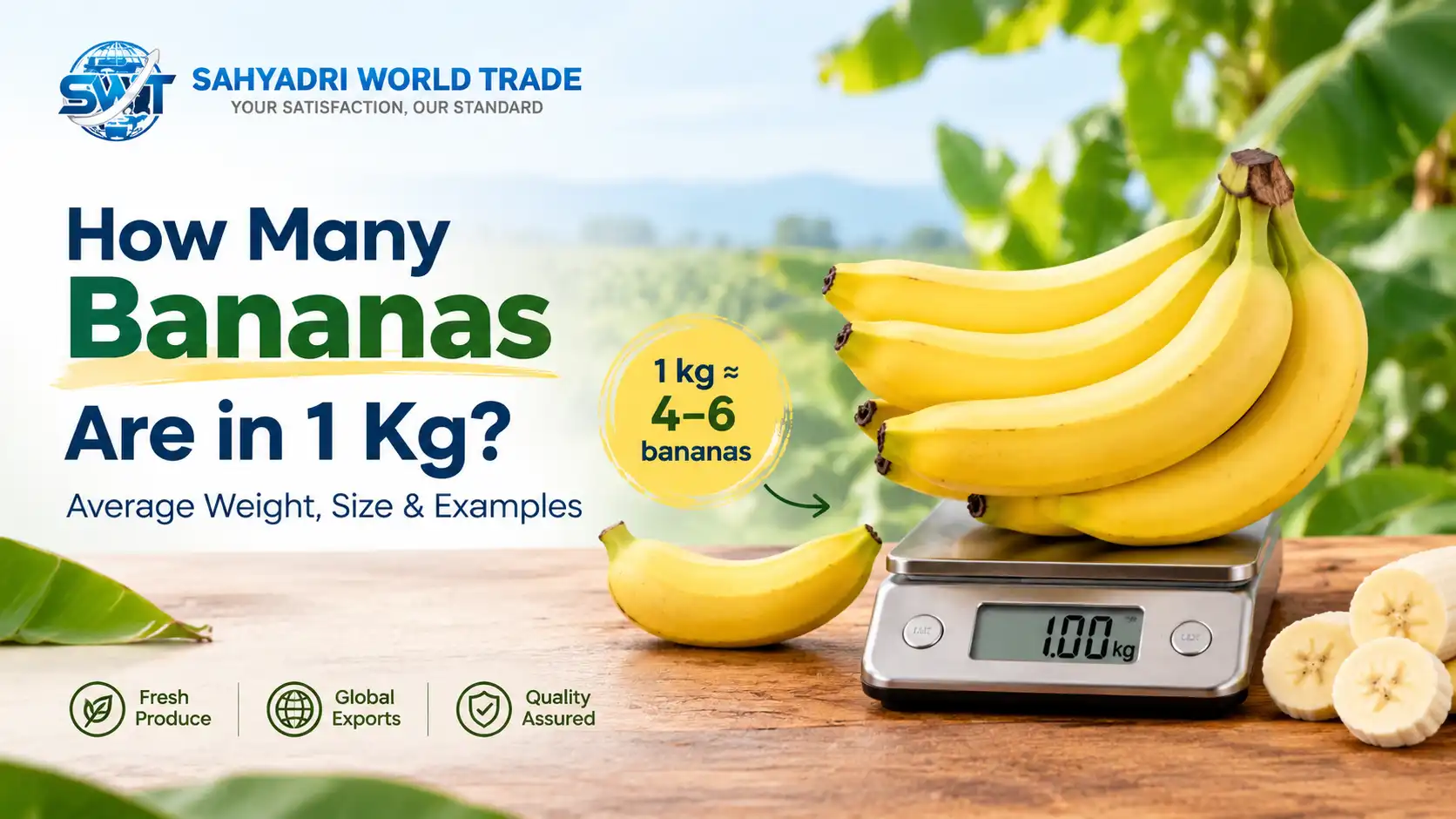
How Many Bananas Are in 1 Kg? Average Weight, Size & Examples
Since 1 kg equals 1,000 grams and about 2.2 pounds, knowing the approximate weight of one banana makes the calculation much easier.
A simple guide is:
- Small banana: about 80 to 100 g, so roughly 10 to 12 bananas per kg
- Medium banana: about 120 to 150 g, so roughly 7 to 8 bananas per kg
- Large banana: about 170 to 200 g, so roughly 5 to 6 bananas per kg
These are practical estimates, not fixed counts. Banana variety, size, ripeness, and peel weight can all affect the result.
How Many Bananas Make 1 Kg?
There is no single exact number because bananas are sold as individual pieces but weighed by mass.
For example, if one banana weighs approximately 125 g:
1,000 ÷ 125 = 8 bananas
If each banana weighs 180 g:
1,000 ÷ 180 = 5.6 bananas
That means you would need about 6 of the larger bananas to reach 1 kg.
For grocery shopping, meal preparation, or general estimation, 6 to 8 medium bananas per kilogram is a useful starting point.
How Much Does a Banana Weigh?
Banana weight varies considerably by size.
A small banana may weigh around 80 to 100 g as a whole fruit, while a medium banana may fall around 120 to 150 g in everyday purchasing estimates. Large bananas can weigh around 170 to 200 g or more.
Official food-composition references can use different conventions because nutritional databases often report the edible portion after the peel is removed, rather than the weight of the complete fruit.
For example, USDA FoodData Central data commonly used for nutrition calculations gives standard edible weights for small, medium, and large bananas. That is why a nutrition label or recipe measurement may not match the number you see when putting an unpeeled banana on a kitchen scale.
Banana Weight by Size
Small bananas
Small bananas can weigh roughly 80 to 100 g each when purchased as whole fruit.
At that size, 1 kg could contain approximately 10 to 12 bananas.
Medium bananas
Medium bananas are usually the easiest reference point for everyday shopping.
At approximately 120 to 150 g each, you would need roughly 7 to 8 bananas to reach 1 kg.
Large bananas
Large bananas can weigh around 170 to 200 g or more.
That means approximately 5 to 6 large bananas may equal 1 kg.
The actual count can still change because two bananas of the same general size category do not necessarily weigh exactly the same.
Does Banana Weight Include the Peel?
This is one of the most important details when converting banana pieces to kilograms.
When you buy bananas at a grocery store or source them commercially, the weight generally refers to the whole banana, including the peel.
For recipes and nutrition calculations, however, you may need the edible portion, meaning the fruit after peeling.
The peel can make a meaningful difference. A kilogram of whole bananas therefore does not provide a full kilogram of banana flesh.
That distinction matters when you're calculating food quantities, nutritional portions, recipe ingredients, or commercial purchase requirements.
1 Kg of Bananas in Pounds
For U.S. readers, the easiest conversion is:
1 kg = 2.2046 lb, or approximately 2.2 pounds.
So if a recipe or purchasing requirement calls for 1 kg of bananas, you're looking at roughly 2.2 pounds of whole bananas.
This is particularly useful in the United States, where grocery stores commonly sell produce by the pound.
For a quick estimate, 2.2 lb of bananas is roughly 6 to 8 medium bananas, although the exact count depends on their size.
How to Calculate the Number of Bananas in 1 Kg
You don't need a complicated calculator.
Use this simple formula:
Number of bananas = 1,000 ÷ average banana weight in grams
For example:
If one banana weighs 100 g:
1,000 ÷ 100 = 10 bananas
If one weighs 125 g:
1,000 ÷ 125 = 8 bananas
If one weighs 200 g:
1,000 ÷ 200 = 5 bananas
A kitchen scale gives you the most accurate result. Without one, estimating based on banana size is usually sufficient for grocery shopping and everyday cooking.
How Many Bananas Do You Need for a Recipe?
Recipe measurements can create confusion because some recipes specify bananas by piece, while others specify grams or pounds.
If a recipe requires 500 g of whole bananas, for example, you might need approximately 3 to 5 bananas depending on their size.
For baking, there is an additional consideration: many recipes are actually concerned with the peeled fruit, not the whole banana.
That's why weighing peeled bananas is often more reliable when a recipe gives a weight in grams.
For meal prep, smoothies, food service, or larger purchasing quantities, weighing the bananas is also preferable to relying only on piece count.
Why Banana Counts Vary
The number of bananas in 1 kg can change because of several factors:
Size: Larger bananas naturally mean fewer pieces per kilogram.
Variety: Different banana varieties can have different typical sizes and shapes.
Ripeness: Ripening changes the fruit's physical condition, although the overall weight difference is generally less important than the original size and water content.
Peel: Whole-fruit weight is higher than edible peeled weight.
Individual variation: Even bananas from the same bunch may differ noticeably in weight.
For commercial buying, these differences make agreed specifications and grading more useful than simply requesting a fixed number of bananas.
For Bulk Banana Buyers, Weight and Grade Matter
For businesses purchasing bananas in larger quantities, the question is usually more than "How many pieces are in 1 kg?"
Importers, wholesalers, distributors, retailers, and food-service buyers may also need to consider fruit size, maturity, appearance, packaging, quantity, handling requirements, and destination-market specifications.
This is where a structured sourcing process becomes important. Sahyadri World Trade works with agricultural suppliers and evaluates fresh produce according to buyer requirements, including agreed specifications, grading, packaging, quality checks, and shipment coordination.
For a commercial order, the required banana count can therefore be estimated from the target weight and agreed average fruit size rather than relying on a generic piece count.
Frequently Asked Questions
How many bananas are in 1 kg?
Approximately 6 to 8 medium bananas can make 1 kg, although the exact number depends on banana size. Small bananas may require 10 to 12, while large bananas may require around 5 to 6.
How much does one banana weigh?
A banana can weigh anywhere from roughly 80 g to 200 g or more depending on its size. Medium bananas are often around 120 to 150 g in practical whole-fruit estimates.
How many small bananas make 1 kg?
If a small banana weighs around 80 to 100 g, approximately 10 to 12 small bananas can make 1 kg.
How many large bananas make 1 kg?
With large bananas weighing around 170 to 200 g each, approximately 5 to 6 bananas can make 1 kg.
Does 1 kg of bananas include the peel?
Yes, when bananas are weighed as whole fruit, the weight includes the peel. For recipes and nutrition calculations, you may need to consider the weight of the peeled edible portion separately.
How many bananas are in 1 pound?
Since 1 pound is about 454 g, you may get roughly 2 to 4 bananas, depending on their size.
How can I estimate 1 kg of bananas without a scale?
Use the size of the bananas as a guide. Around 6 to 8 medium bananas is a practical estimate for 1 kg. For more precise purchasing or recipe measurements, use a kitchen or produce scale.
For everyday shopping, 6 to 8 medium bananas is a useful average weight of a banana estimate for 1 kg. For commercial buyers, however, actual quantity depends on the agreed fruit size, grade, maturity, packaging, and shipment specifications.