- Utkarsh Urvashi CHS, 1st Floor, Veshvi, Alibag
- info@sahyadriworldtrade.com
- Open: Mon–Sat: 08:00 – 18:00

Turmeric Wholesale in India: Rates, Finger Turmeric, Suppliers & Export Opportunities
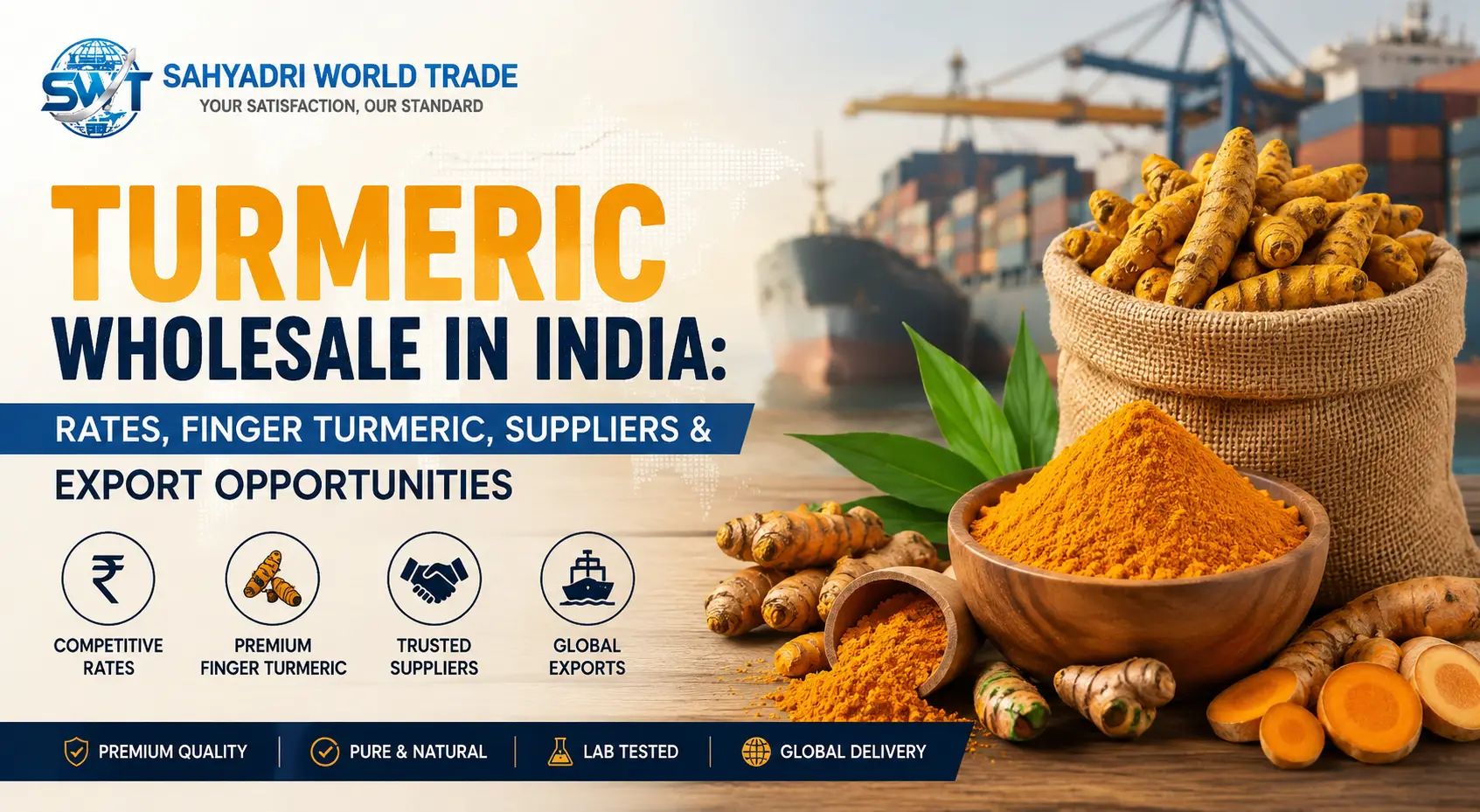
Turmeric Wholesale in India: Rates, Finger Turmeric, Suppliers & Export Opportunities
India offers a broad turmeric supply base, with established production and trading centers and a large processing ecosystem. That makes Indian turmeric attractive for both domestic wholesale procurement and international sourcing.
Here is what buyers should know before choosing a turmeric supplier.
What Is Turmeric Wholesale in India?
Turmeric wholesale refers to bulk procurement of turmeric from producers, traders, processors, wholesalers, or exporters rather than buying retail quantities.
Bulk turmeric can be supplied in several forms, including dried whole turmeric, turmeric finger, cured rhizomes, polished or unpolished turmeric, and turmeric powder.
The right form depends on the application. A spice manufacturer may buy whole turmeric for grinding, while a food processor may need a specific powder specification. Export buyers may also have requirements for moisture, curcumin content, cleanliness, packaging, and laboratory testing.
For this reason, a serious wholesale enquiry should specify the product form, quantity, quality requirements, packaging, destination, and intended use.
What Determines the Turmeric Rate?
There is no single turmeric rate that applies to every bulk purchase in India.
Origin and variety: Prices vary by growing region and turmeric variety.
Grade and size: Better grades and preferred turmeric finger sizes may command higher rates.
Curcumin content: Higher or specified curcumin levels can affect pricing.
Moisture level: Moisture affects storage stability, quality, and processing suitability.
Cleanliness and purity: Cleaner turmeric with less foreign matter generally has greater commercial value.
Curing and processing: Processing methods can influence the final price.
Polishing condition: Polished and unpolished turmeric may have different prices.
Order quantity: Larger orders may receive different commercial rates.
Packaging: Customized or export-grade packaging can increase the overall cost.
Seasonal availability: Supply conditions can cause rates to change throughout the year.
Market demand and supply: Market conditions directly influence wholesale prices.
Freight and destination: Transport and destination costs can affect the final quotation.
Wholesale market prices and export quotations can differ because export pricing may include processing, packing, inspection, documentation, inland transport, and other logistics costs.
Therefore, buyers should compare turmeric suppliers based on the same quality, quantity, packaging, and delivery terms, rather than choosing only by the lowest quoted rate.
What Is Turmeric Finger?
Turmeric finger generally refers to the dried secondary rhizomes of the turmeric plant. These elongated pieces are widely traded as whole dried turmeric and are commonly used for grinding, processing, extraction, and spice applications.
Buyers often evaluate turmeric finger based on factors such as:
- Size and appearance
- Colour
- Curcumin content
- Moisture
- Cleanliness
- Foreign matter
- Physical damage
- Processing condition
The required specification can vary by application. A buyer sourcing turmeric for powder production may have different requirements from a trader supplying whole turmeric to another market.
Where Can Buyers Source Bulk Turmeric in India?
India's turmeric supply chain includes farmers, agricultural markets, processors, spice traders, wholesalers, manufacturers, and exporters.
Tamil Nadu is an important sourcing region for buyers searching for spices suppliers in Tamil Nadu, with Erode and other trading and processing centers forming part of the state's spice ecosystem. Buyers also source turmeric and turmeric products from other Indian regions, including Telangana, Andhra Pradesh, Maharashtra, Karnataka, and Kerala.
Location matters, but it should not be the only selection criterion.
A reliable supplier should be able to explain the product specification clearly, identify the sourcing route, provide commercially relevant packaging options, coordinate inspection where required, and support the documentation needed for the shipment.
How Should You Evaluate a Turmeric Supplier?
Before placing a large order, ask for a clear product specification rather than accepting a generic description such as "premium turmeric."
Important questions include:
What is the turmeric form and grade?
What is the expected curcumin level?
What is the moisture specification?
How is the product cleaned and processed?
What packaging is available?
What is the minimum order quantity?
Can samples or quality documents be provided?
Can pre-shipment inspection be arranged?
What export documents are available for the destination?
For international buyers, testing can also be important. Depending on the product and destination, buyers may request checks related to pesticide residues, microbiological parameters, heavy metals, moisture, purity, or other product-specific requirements.
The exact compliance requirements should always be confirmed for the importing country before shipment.
Turmeric Export From India: What International Buyers Should Know
Indian turmeric is used in food processing, spice manufacturing, retail products, and other commercial applications in international markets.
For buyers in the USA, Europe, the Middle East, Canada, Australia, and other markets, the quoted turmeric rate is only one part of the purchasing decision.
Importers may also assess:
- Product consistency between lots
- Curcumin and other agreed specifications
- Food-safety testing
- Residue and contaminant requirements
- Traceability
- Packaging and labeling
- Certificate requirements
- Shipping documentation
- Transit and storage conditions
Export documentation can vary according to the product and destination. Depending on the shipment, documents may include commercial invoices, packing lists, shipping documents, certificates of origin, phytosanitary documentation, fumigation certificates, inspection reports, and laboratory reports where applicable.
Because import regulations can change, buyers should verify current destination-country requirements before confirming a shipment.
Why Quality Control Matters in Wholesale Turmeric
A low price does not help if a shipment arrives outside specification.
A practical sourcing process can include supplier evaluation, lot sampling, visual inspection, grading, packaging checks, batch identification, and pre-shipment verification.
For turmeric, buyers can establish an agreed specification before procurement. This creates a clearer benchmark for colour, size, moisture, curcumin, cleanliness, packaging, and other relevant parameters.
That approach is particularly useful for repeat orders because future shipments can be sourced against the same documented requirements rather than starting from scratch each time.
A Practical Option for Bulk Buyers
Sahyadri World Trade works with Indian sourcing networks for agricultural products, spices, processed foods, and other commercial goods. Its stated export process includes understanding buyer specifications, identifying suitable suppliers, coordinating quality checks, arranging export-ready packaging, and supporting shipment documentation.
For a turmeric buyer, the useful starting point is not simply asking, "What is today's turmeric rate?" A better enquiry includes the required turmeric form, quantity, grade, quality specifications, packaging, destination, and expected shipment schedule.
That gives the supplier enough information to prepare a more relevant commercial quotation.
Frequently Asked Questions
Is turmeric wholesale cheaper than buying retail?
Usually, bulk procurement has different economics from retail purchasing, but the final advantage depends on quantity, grade, processing, packaging, transport, and supplier terms.
What is the best turmeric finger grade?
There is no single grade that is best for every buyer. The suitable grade depends on the intended use and requirements such as appearance, curcumin, moisture, cleanliness, and processing condition.
How can I check the turmeric rate in India?
Check the relevant wholesale or market quotation for the specific origin and grade, then compare it with supplier quotations based on the same specification. An export quotation may include additional processing and logistics costs.
Can I buy turmeric in bulk for export?
Yes. Indian turmeric can be sourced for export, subject to product specifications, destination-market rules, testing, documentation, and applicable import requirements.
Are spices suppliers in Tamil Nadu suitable for international buyers?
They can be, particularly when the supplier has the required sourcing capability, quality controls, packaging options, documentation support, and experience with the destination market.
What should I include in a turmeric wholesale enquiry?
Mention the turmeric form, quantity, grade or quality requirements, curcumin specification if applicable, packaging, destination country or port, and preferred shipment schedule. This makes price comparison much more meaningful.
Make Your Turmeric Requirement More Specific
For serious wholesale buyers, the strongest first step is a clear specification rather than a generic price request. Once the product, grade, quantity, packaging, and destination are defined, it becomes much easier to evaluate suppliers on real commercial value.
For bulk turmeric sourcing from India, Sahyadri World Trade can be approached with those requirements for a supplier and export discussion.